

A growing wave of violence in Benue State has forced thousands of people from their homes, pushing many into unlikely places of refuge—schools. Buildings once meant for learning are now overcrowded shelters for internally displaced persons (IDPs), creating a difficult balance between survival and education. This situation has not only exposed families to harsh living conditions but has also disrupted the schooling of countless children.
Sukpu Tony is one of those affected. Today, he sleeps inside a classroom at RCM Primary School in Agagbe, alongside his family. At night, they spread thin coverings on the hard floor, turning the classroom into a temporary home. When morning comes, the same space is expected to function as a learning environment for pupils. For Tony, this shared existence between shelter and school reflects the harsh reality of displacement.
The 40-year-old farmer fled his village, Mbapupuu in Gwer West Local Government Area, after a violent attack by suspected armed herders. The assault left several people dead, including members of his family. Tony himself narrowly survived after suffering a severe injury—his leg was cut during the attack, and the attackers left him behind, assuming he had died.
He remained there until a passerby discovered him alive and rushed him to safety. He was later taken to Makurdi for medical treatment. By the time he recovered, everything he once knew—his home, livelihood, and sense of security—had been lost.
Now living in Agagbe, Tony and his family share deteriorating school buildings with hundreds of others. The classrooms are in poor condition, with broken roofs, missing windows, and bare floors. There is little protection from the elements, and no proper bedding or basic facilities.
Benue State has, for years, been one of the regions most affected by recurring violence in Nigeria’s north-central zone. Entire communities have been attacked and destroyed, leaving many residents displaced. Most of those affected are farmers whose livelihoods have been disrupted by repeated assaults, often linked to conflicts with armed herders.
What began as disputes over land and water resources has escalated into widespread violence. Factors such as climate change, population pressure, ethnic and religious tensions, and weak state response have contributed to the crisis.
According to data from the International Organization for Migration (IOM), more than 219,000 people had been displaced in Benue as of early 2026. However, the actual number may be higher, as not all displaced individuals are officially recorded.
In Agagbe alone, thousands of displaced persons are living in makeshift camps. RCM Primary School, where Tony resides, hosts over 2,600 individuals from hundreds of households. It is one of several locations in the area that have been converted into shelters, including another school, St. Francis Xavier Secondary School, as well as other sites like an abandoned police station and the Holy Rosary Camp.
Within these spaces, classrooms are divided between their original purpose and their new role as shelters. Some rooms are reserved for pupils, while others house displaced families. Even so, the available space is far from sufficient. Overcrowding has become a major issue, with some students forced to learn outside or unable to attend school at all.
Sanitation facilities are limited. Although some support has been provided—such as toilets built by humanitarian organizations at a few locations—many areas still lack proper facilities. As a result, open defecation is common, increasing health risks.
Access to clean water is another serious challenge. Most residents depend on a nearby stream, which is also used by cattle. The water is visibly contaminated, yet it remains the only available source. During dry seasons, the situation worsens as the stream shrinks, making water even harder to access. Some residents are also afraid to fetch water due to reports of armed individuals in the surrounding areas.
The overlap between living and learning spaces creates constant disruption. School activities are frequently interrupted, particularly when visitors or aid workers arrive. At such times, lessons may be suspended entirely, leaving children without consistent education.
For families like Tony’s, daily survival is a struggle. Food is scarce, and support from outside sources is irregular. Cooking is difficult due to limited access to firewood and utensils. The poor living conditions have also affected the health of his children, who frequently fall ill.
Tony’s situation is further complicated by his wife’s condition—she has been blind for nearly three years and has no access to medical care. With no relatives to turn to and no means of rebuilding his life, he remains stuck in the camp, uncertain about the future.
Another resident, Gyegu Helen, shares a similar story. A mother of five, she was displaced after an attack on her community, Tse Adekule, claimed the lives of her husband and several relatives. She now lives in a crowded classroom with her children, struggling to cope with the conditions.
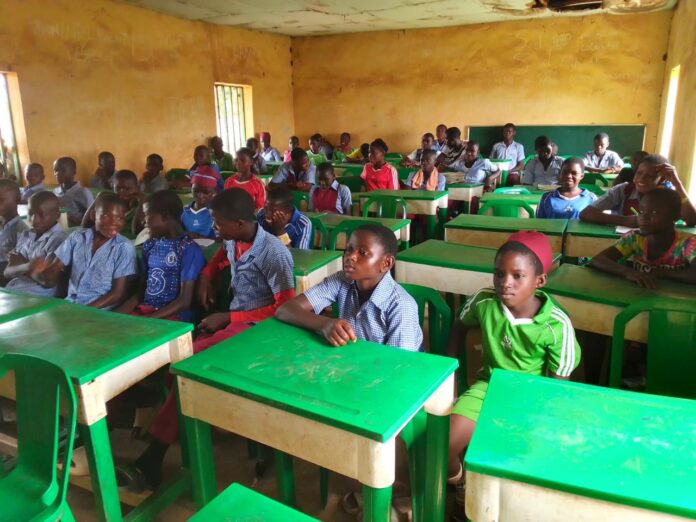
Helen describes life in the camp as extremely difficult. The overcrowding, she says, has led to frequent illness among children. Diseases spread quickly in the cramped environment, where families sleep side by side with little space or privacy.
Her experience with displacement is not new. She had been forced to leave her home years earlier, returned, and then fled again when violence escalated. This time, however, she has little hope of returning.
Access to clean water remains a major concern for her as well. Like others in the camp, she relies on the contaminated stream. This has led to frequent cases of waterborne diseases such as typhoid.
Nyibiam Veronica, a mother of eight, also lives in the camp under similar conditions. She shares a single classroom with about 50 people. The overcrowding, she says, has made disease outbreaks almost inevitable. In recent years, the camp has recorded cases of measles, chickenpox, meningitis, and cholera.
Veronica herself has suffered repeated bouts of typhoid due to poor sanitation and unsafe water. While she acknowledges that the government occasionally provides food assistance, she notes that it is often insufficient. Like many others, she would prefer to return to her farm and regain her independence.
The impact of displacement extends beyond physical hardship—it also affects education. With classrooms serving as shelters, the learning environment has been severely compromised. Noise, overcrowding, and frequent interruptions make it difficult for teachers to conduct lessons effectively.
Many children in the camp are not attending school at all, despite living within school premises. For some families, the cost of uniforms and supplies is unaffordable. For others, the chaotic environment makes learning nearly impossible.
Education experts warn that this situation could have long-term consequences. When schools lose their structure and purpose, the quality of education declines. Over time, children who are already vulnerable may fall further behind, widening inequality and limiting their future opportunities.
While the Benue State government has acknowledged the issue, efforts are being made to manage the situation. Officials say steps are being taken to reduce disruption to schooling and to eventually relocate displaced persons away from school facilities.
They also note that some IDPs have begun returning to their communities as security improves, particularly during the farming season. However, for many families still living in camps, the challenges remain overwhelming.
The situation in Agagbe highlights the broader impact of displacement on both living conditions and education. For those affected, the need for support is urgent. Without adequate shelter, healthcare, food, and access to clean water, daily life remains a struggle.
At the same time, the disruption to education poses a long-term risk. Children growing up in these conditions face an uncertain future, caught between the need to survive today and the hope for a better tomorrow.
For families like Tony’s, Helen’s, and Veronica’s, the desire is simple: safety, stability, and a chance to rebuild their lives. Until then, classrooms will continue to serve as both homes and schools—symbols of resilience, but also of a crisis that remains far from resolved.