

The ongoing conflict involving Iran, Israel, and the United States is driving an unprecedented surge in demand for refined petroleum products across Africa, placing the Dangote Refinery at the center of a rapidly evolving global energy landscape.
In response to rising international tensions and climbing crude oil prices, the Dangote Petroleum Refinery recently adjusted its ex-depot (gantry) price from N1,175 to N1,245 per litre, while the coastal price rose from N1,512,648 to N1,606,518 per metric tonne. The new pricing took effect at midnight on March 21, 2026. According to the company, these increases reflect the broader pressures on global oil markets triggered by geopolitical instability.
Meanwhile, developments on the international front continue to influence energy dynamics. U.S. President Donald Trump indicated that America is “very close” to achieving its objectives in the ongoing conflict with Iran, hinting at a potential winding down of military operations while urging other nations to assume responsibility for securing the Strait of Hormuz. Trump criticized NATO allies for their perceived lack of support, labeling them “cowards” and underscoring the strain in transatlantic relations.
In a related move, the British government authorized the United States to use military bases in the UK to conduct strikes on Iranian missile installations targeting ships in the Strait of Hormuz. These developments coincide with escalating crude oil prices, which recently approached $120 per barrel, intensifying market volatility.
Aliko Dangote, President of the Dangote Group, described the situation as “crazy,” highlighting the profound impact of geopolitical events on global energy markets. Speaking to The Economist, he emphasized that the uncertainty is likely to persist, fueling surging demand for refined products across Africa. “People are ready to pay anything now,” he noted, reflecting the competitive scramble for limited fuel supplies.
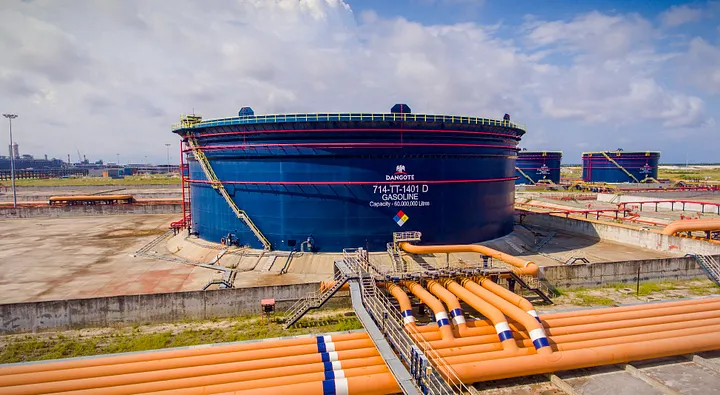
The Dangote Refinery, situated on the outskirts of Lagos, is Africa’s largest, with a processing capacity of 650,000 barrels per day. Beyond meeting immediate market needs, the facility is envisioned as a cornerstone of Africa’s long-term industrialization and economic independence. “If we Africans don’t lead in the industrialization of Africa, Africa will never industrialize,” Dangote said, emphasizing the need for local investment in critical infrastructure.
Already, the refinery has demonstrated its macroeconomic significance. According to Dangote, Nigeria would face substantial energy and economic strain without the facility, which has helped reduce dependence on imported petroleum products and eased pressure on foreign exchange reserves. The sprawling industrial complex includes extensive storage capacity, dedicated port infrastructure, and even a runway to accommodate visitors, underscoring the scale of the private-sector investment.
The refinery’s strategic importance has been magnified by disruptions in global trade routes, particularly in the Strait of Hormuz, a key conduit for energy and fertilizer shipments. This has positioned the Dangote Refinery as a vital supplier not only of fuel but also of petrochemicals and agricultural inputs throughout Africa.
Looking ahead, Dangote revealed ambitions to expand refining capacity and potentially list a portion of the business on both the Nigerian Exchange Limited and the London Stock Exchange. He stressed the necessity of African-led investment, warning that if local investors do not step up, external actors are unlikely to fill the gap. He expressed skepticism about the ability of other African countries to replicate such large-scale industrial projects, citing financial constraints and hesitancy to invest.
While some critics have raised concerns about reliance on foreign technical expertise, Dangote defended his operations, citing the advanced automation employed in both refining and cement production. He envisions the refinery supporting broader industrialization by using the gas produced on-site to power nearby manufacturing facilities.
The Dangote Group has also outlined plans to expand beyond Nigeria. Last year, it entered a $2.5 billion joint venture with Ethiopia to establish a fertiliser plant similar in scale to the Nigerian facility. Additional investments in cement and power projects are planned for Zimbabwe, with other projects including potash and phosphate mining, copper processing in Zambia, cocoa processing in Ghana and Ivory Coast, and a petroleum pipeline from Namibia to central Africa.
On the geopolitical side, President Trump’s recent statements indicate that the United States may gradually scale back its military involvement in the Middle East, even as regional tensions remain high. The Strait of Hormuz, a vital global energy corridor, continues to face disruption, and the U.S. is urging other nations to take a more active role in securing the passage. Trump highlighted significant military achievements, including the degradation of Iran’s missile capabilities, dismantling its defense infrastructure, and ensuring that Iran cannot advance its nuclear ambitions.
Trump also criticized NATO allies for avoiding direct involvement, despite benefiting from energy security and lower military risk. In response, Germany, Britain, France, Italy, the Netherlands, Japan, and Canada pledged to contribute to efforts ensuring safe passage through the Strait of Hormuz, contingent on the cessation of active combat. Meanwhile, the British government confirmed that U.S. military forces would have access to UK bases to conduct defensive operations against Iranian missile attacks on ships navigating the Strait.
As tensions continue to ripple across global markets, the Dangote Refinery remains a critical stabilizing force for Africa’s energy supply. With ambitious plans for expansion and regional investment, the facility exemplifies how large-scale industrial projects can bolster economic resilience amid geopolitical uncertainty. Dangote’s vision positions the refinery not just as a supplier of fuel, but as a central hub for Africa’s industrial growth and long-term economic independence.