

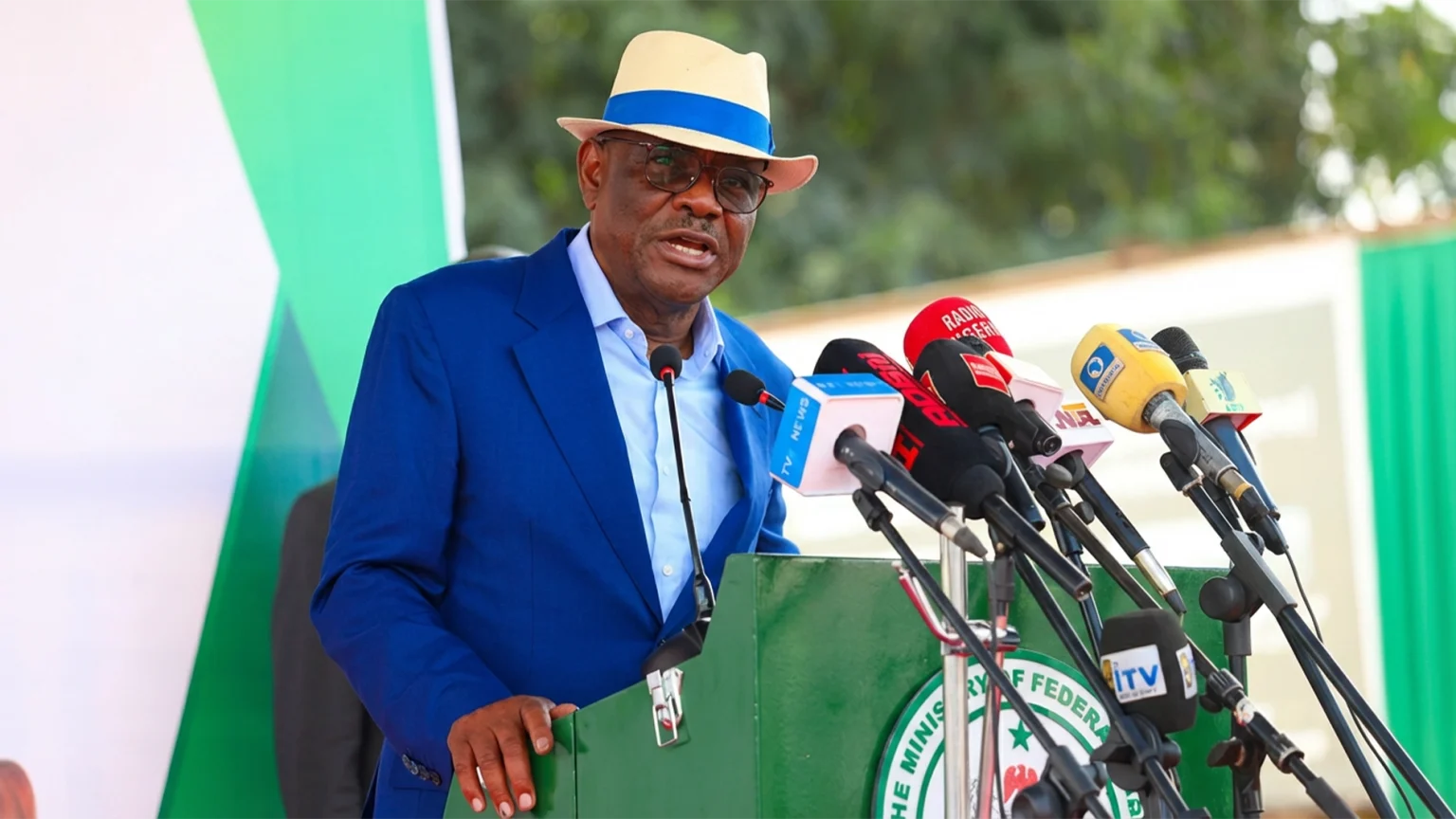
The Minister of the Federal Capital Territory, Nyesom Wike, on Saturday toured several parts of Abuja as voting got underway in the Area Council elections, a move that has sparked both commendation and criticism.
Wike was seen visiting multiple polling units across the capital, including locations in Garki, Karu, Karshi, Wasa, Apo, and Ketti. Moving under tight security, he interacted with electoral officials and residents while observing the voting process. The minister described his visits as part of his responsibility to ensure that the environment remained conducive for a peaceful exercise.
Ahead of the elections, Wike had announced a series of measures aimed at maintaining order. In a broadcast aired on national television and radio, he declared Friday a work-free day to allow residents to prepare for the polls. He also imposed restrictions on movement of people and vehicles from 8 p.m. on Friday until 6 p.m. on Saturday. According to him, the directive was not a unilateral decision but was taken with the approval of President Bola Tinubu.
The movement restriction, however, generated controversy. Senator Ireti Kingibe, who represents the FCT at the National Assembly, criticised the measure, describing it as undemocratic and imposed without adequate consultation. She argued that restricting residents’ movement on such a scale undermined civil liberties and was inconsistent with democratic principles.
Responding to the criticism, Wike dismissed claims that he acted independently. He insisted that the directive had presidential backing and suggested that his remarks had been misinterpreted. While declining to engage in a prolonged dispute with the senator, he maintained that the steps were necessary to safeguard the integrity of the elections. He added that the outcome of the polls would ultimately speak for itself.
Beyond the debate over the restrictions, Wike also assessed the conduct of the elections. He noted that voter turnout appeared lower in certain parts of the city centre but expressed satisfaction with the overall atmosphere. According to him, reports from across the territory indicated that the process was peaceful, with no recorded incidents of violence at the time of his inspection. He commended officials of the Independent National Electoral Commission (INEC) and security agencies for their professionalism and praised the deployment of the Bimodal Voter Accreditation System (BVAS), which he said contributed to transparency and efficiency.
While Wike defended his actions as appropriate and lawful, his presence at multiple polling units drew sharp criticism from human rights lawyer Inibehe Effiong. In a post shared on X, Effiong questioned the minister’s role in the electoral process, arguing that it was improper for him to move around the territory in what appeared to be a supervisory capacity.
Effiong contended that Wike is not a registered voter in Abuja, stating that he is registered in Rivers State. On that basis, he argued that the minister lacked standing in the FCT’s local electoral process. According to the lawyer, the responsibility for conducting and supervising elections rests exclusively with INEC, and any action that suggests political oversight could undermine public confidence.
He further maintained that even if Wike were acting as a representative of a political party, his authority would be limited. In his view, party agents are assigned to specific polling units or collation centres and cannot operate across an entire territory. Effiong described the minister’s movements as partisan and inconsistent with the principle of neutrality expected during elections.
The lawyer also pointed to what he perceived as a contradiction: while residents were subject to movement restrictions, the minister was seen travelling freely across different parts of the FCT. To Effiong, this raised concerns about fairness and equal application of the rules.
Despite the criticisms, Wike urged residents to remain calm and orderly until the electoral process was concluded. He reiterated his confidence in INEC’s management of the polls and expressed hope that the elections would further strengthen grassroots democracy in the capital.