


The African Democratic Congress (ADC) is grappling with significant leadership turmoil that shows no signs of abating. Recent communications from the Independent National Electoral Commission (INEC) have exposed glaring procedural lapses in the party’s leadership structure under former Senate President David Mark. These revelations have raised concerns over the legitimacy of the party’s current executives and the potential consequences for its participation in the 2027 general elections.
A memo dated August 6, 2025, obtained from INEC, provides a detailed account of the irregularities surrounding the formation of the ADC caretaker committee. The document references official correspondence between the party and the electoral commission concerning the meetings that led to the creation of the caretaker leadership. The memo included the list of the caretaker committee, the National Working Committee (NWC), and zonal officers as ratified at the ADC meeting held in July 2025. It also contained the minutes of the party’s 99th National Executive Committee (NEC) meeting conducted on July 29, 2025.
INEC, through the memo signed by Deputy Director of the Election Party Monitoring Committee (EPMC), Joan Arabs, highlighted that ADC failed to provide the mandatory 21-day notice for the meeting that produced the caretaker committee, nor did it furnish records of that meeting. According to Arabs, this omission constituted a violation of Section 82(5) of the Electoral Act, rendering the meeting and its outcomes invalid.
The memo explained, “The provisions of Section 82(1) of the Electoral Act 2025 clearly specify which activities of political parties require a 21-day notice. Every registered political party is obliged to notify the commission at least 21 days in advance of any convention, congress, conference, or meeting convened for mergers, the election of executive committee members, or the nomination of candidates for elective offices.” Arabs emphasized that failing to comply with this statutory requirement undermined the legitimacy of the actions taken during the meeting.
She further noted that while ADC had submitted notice of its NEC meeting on July 29, 2025, which ratified resolutions of the NWC, the commission had not been notified of the prior meeting where those resolutions were initially adopted. Moreover, the party did not clarify the effective date from which the caretaker committee’s appointments would take effect. Arabs stressed that INEC does not have the authority to dictate the implementation timeline of party decisions, but the absence of clarity creates legal and administrative uncertainty.
In addition, ADC had not provided the specimen signatures of the caretaker chairman and secretary, a key procedural requirement for official recognition by the commission. Arabs recommended that INEC await the submission of these names, signatures, and the effective date before formally acknowledging the caretaker leadership.
The ADC had relied on Articles 19(12)(vii) and 19(14)(N, O, P, & S) of its 2022 amended constitution to justify the formation of the caretaker committee. Article 19(12)(vii) grants the caretaker committee the authority to exercise the powers and functions of the NEC pending ratification at the next NEC meeting. Additional provisions empower the committee to act on behalf of the National Convention, ratify NWC decisions, and oversee interim or state-level executive committees as needed.
However, Arabs observed that the July 29 letters sent to INEC merely listed the names of the caretaker committee members ratified at the NEC meeting. This suggested that the appointment of the caretaker committee had not originated from a formal NEC decision but from actions outside the NEC, which merely ratified the NWC’s earlier resolutions. She referenced paragraph 8 of the NEC minutes, noting that the NEC had read and ratified resolutions from the NWC meeting of July 2, 2025, including the decision to form the caretaker committee. Yet, no record of the original appointment submitted to INEC existed, raising questions about the legality of the process.
The NEC minutes also confirmed that the caretaker committee was approved to lead the party for up to 12 months, listing Senator David Mark as Caretaker National Chairman, Ogbeni Rauf Aregbesola as Caretaker National Secretary, and Bolaji Abdullahi as Caretaker National Publicity Secretary. Arabs reiterated that the NEC’s role is ratification, not initiation, and highlighted that the lack of prior documentation from the meeting establishing the caretaker committee undermined its legal standing.
The tension escalated last week when INEC, citing a ruling from the Abuja division of the Court of Appeal, de-recognized the David Mark-led leadership. This move cast a shadow over ADC’s plans for its upcoming National Convention, initially scheduled for April 14, 2026, as questions arose about the party’s eligibility to field candidates in the forthcoming general election. Nevertheless, the party insisted it would proceed with the convention, arguing that INEC’s function is supervisory and that the mandatory 21-day notice had been communicated.
The leadership dispute within ADC is also playing out in the courts. Former Deputy National Chairman Nafiu Bala Gombe filed a suit challenging the legitimacy of the Mark-led administration. Gombe claims that, following the resignation of certain executive members, he became the rightful party chairman, alleging an unlawful takeover by the caretaker leadership.
Adding to the controversy, ADC has announced plans to challenge INEC’s interpretation of the appellate court ruling in court. According to Lawal Tukur-Batagarawa, speaking on behalf of the Katsina State chapter of the party, INEC’s removal of the party leadership from its official portal misrepresented the court’s directive to maintain the “status quo” pending further proceedings. Tukur-Batagarawa described INEC’s actions as “mischievous,” arguing that the judgment did not authorize the suspension or removal of the party’s leadership. He contended that INEC had deliberately misinterpreted the directive, creating confusion and doubt about the legitimacy of the party’s administration.
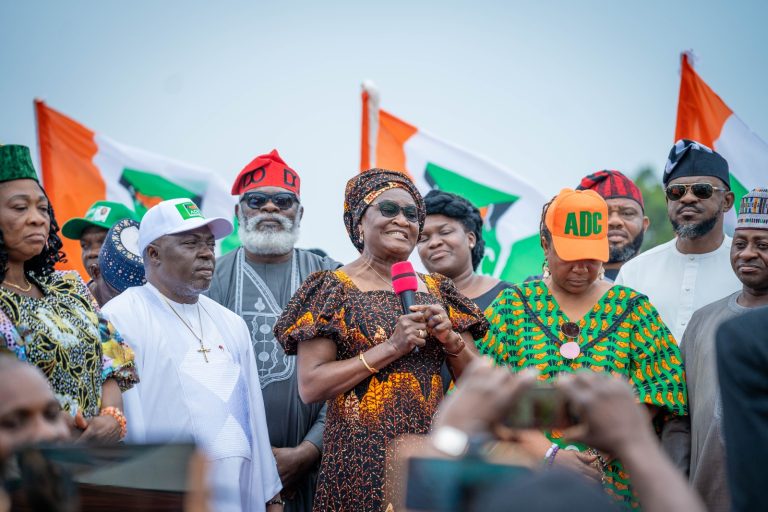
Amidst the internal turmoil, opposition leaders have begun considering alternative strategies ahead of the 2027 elections. Sources indicate that they are exploring options to contest under other political parties, such as the Action Peoples Party (APP) or the National Democratic Congress (NDC), should the legal issues surrounding ADC remain unresolved. Analysts warn that the ongoing crisis could impede the submission of ADC’s member register to INEC, a critical requirement due by May 8 for participation in the electoral cycle.
The internal conflicts have not entirely dampened public interest in ADC. Following INEC’s statement derecognizing the party’s leadership on April 1, the party reported a surge in membership registration. Mallam Bolaji Abdullahi, ADC National Publicity Secretary, disclosed that over 500,000 Nigerians joined the party between 7:00 PM on April 1 and 5:00 PM the following day, reflecting heightened engagement despite the leadership crisis.
However, political analysts and rival politicians remain skeptical about ADC’s ability to consolidate this momentum. Kano State Governor Abba Kabir Yusuf described the party as “dead on arrival” in the state, citing unresolved internal conflicts and a lack of grassroots support. According to his Chief Press Secretary, Mustapha Muhammad, ADC’s structural weaknesses and limited popular acceptance make it unlikely to gain traction in Kano’s competitive political landscape. Yusuf emphasized that the state remains solidly under the control of the ruling political establishment, supported by widespread public backing.
Yusuf’s remarks were further amplified by his commitment to rallying support for President Bola Ahmed Tinubu and ensuring the ruling party, the All Progressives Congress (APC), secures victory in all elective positions during the 2027 elections. He pointed to ongoing infrastructure development and social safety initiatives as evidence of effective governance that consolidates political support.
Nonetheless, some members of APC have expressed doubts about Yusuf’s influence in delivering votes for Tinubu. Alhaji Abdulmajid Danbilki, a party chieftain in Kano, argued that Yusuf’s political weight may not significantly enhance Tinubu’s re-election prospects, highlighting the distinction between governance performance and political maneuvering. Danbilki suggested that Yusuf’s departure from the New Nigeria Peoples Party (NNPP) and his integration into APC could potentially undermine rather than strengthen the party’s position, citing historical patterns of political realignment in the state.
The ADC leadership crisis underscores a broader challenge in Nigerian party politics: the tension between internal governance structures, legal frameworks, and regulatory oversight. While the party has sought to justify its actions based on constitutional provisions and internal procedures, the lack of transparency and adherence to statutory notice requirements has left it vulnerable to legal scrutiny. This vulnerability, in turn, could limit the party’s operational effectiveness and electoral competitiveness.
Observers note that the unfolding situation serves as a cautionary tale for political parties attempting to navigate internal restructuring amidst looming elections. The interplay between INEC oversight, judicial interventions, and internal party dynamics can dramatically influence the outcome of leadership disputes. ADC’s current predicament highlights how procedural oversights, even if unintended, can escalate into broader crises with far-reaching implications for party credibility and public trust.
Moreover, the ADC episode illustrates the complex role of the judiciary in Nigerian politics, particularly in mediating disputes between party factions. Legal challenges, such as the one initiated by Nafiu Bala Gombe, not only test the limits of party constitutions but also the extent to which judicial interpretations influence electoral readiness. The party’s intention to challenge INEC’s interpretation of the appellate ruling further complicates the timeline for resolving leadership uncertainties.
Despite the internal strife, the reported surge in membership suggests that ADC retains a degree of appeal, perhaps fueled by dissatisfaction with existing political options or confidence in alternative leadership. However, translating increased membership into electoral success requires stable governance structures, clarity in leadership legitimacy, and compliance with statutory obligations—all of which remain contested within the party.
As Nigeria approaches the 2027 elections, the resolution of ADC’s leadership crisis will be pivotal in determining whether the party can maintain relevance as a credible political platform. Failure to resolve these disputes could not only prevent the party from fielding candidates but also erode public confidence in its organizational capacity. For opposition actors, the stakes are high: strategic decisions made in the coming months could redefine political alliances and electoral outcomes across the country.
In conclusion, the ADC leadership controversy reflects a confluence of procedural lapses, regulatory scrutiny, judicial intervention, and political maneuvering. While the party seeks to assert its legitimacy and proceed with its planned conventions, INEC’s concerns and ongoing court challenges complicate the path forward. With membership surging amidst uncertainty, the party faces both an opportunity and a challenge: to convert public interest into sustained political influence while navigating legal and administrative obstacles. The coming months will be critical in determining whether ADC emerges as a unified and operationally sound political force or remains mired in disputes that could marginalize it in the 2027 electoral contest.